
Period covered: October 26 – November 1, 2026 (UTC)
Over the past week Uniswap moved on both the product and the ecosystem front.
TJAR (Token Jar) officially appeared, further refining how on-chain fees are collected and converted; Robinhood extended its tokenized stocks, and Ondo brought more tokenized equities onto Robinhood Chain.
The UNI burn numbers, meanwhile, went through a violent swing. Across all chains the network burned 422,000 UNI in seven days, but most of that came from the Binance hack pushing on-chain volume up sharply — and the burn fell back fast over the weekend.
So this week puts Uniswap's ecosystem expansion and UNI's value capture side by side, and the contrast is the interesting part.
1. On-chain data: 422,000 UNI burned in a week
From October 26 to November 1, Uniswap burned 422,000 UNI across all chains, an average of about 60,286 UNI a day.
That average, though, is not a very useful number.
The week was not steady growth — it was an average pulled up by an extreme event.
For the first three days the daily burn stayed around 30,000 UNI. It jumped to 182,000 on October 29, held at 110,000 on October 30, then fell quickly to 24,000 and 12,000.
October 29 and 30 alone account for roughly 69% of the whole week's burn.
Those two spikes trace back to the Binance hack, so the increase cannot simply be read as the protocol's normal, recurring burn capacity.
422,000 UNI looks like a lot, but the more accurate description is textbook event-driven volatility.
Seven days of burn data:
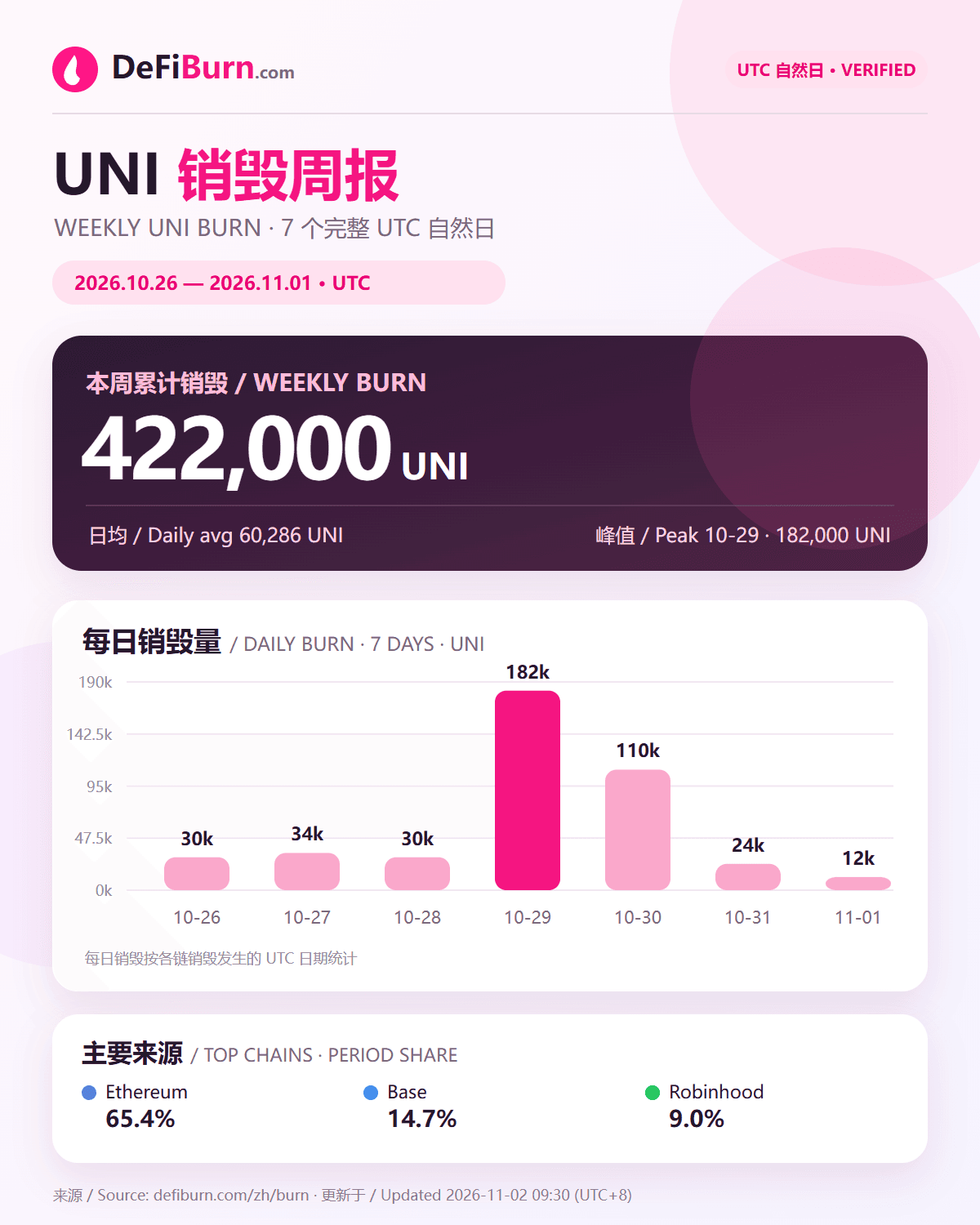
Where the burns came from: Ethereum still leads
Looking at the multi-chain distribution, Ethereum remains the single largest source of UNI burns.
- Ethereum: 65.4%
- Base: 14.7%
- Robinhood: 9.0%
Ethereum alone accounted for close to two thirds of everything burned across all chains.
Base came second and Robinhood third. Arbitrum, Polygon and Optimism also recorded burns this week, just at a much smaller share.
Worth noting: Robinhood's share of the burn was once around 20%, and it has come back down to 9% this week.
That says Robinhood Chain's contribution to the UNI burn is shifting — and it says the heat on Robinhood Chain is fading further.
2. Product news: TJAR officially appears
On October 31, Uniswap introduced TJAR (Token Jar), which is the product development worth watching this week.
It solves a practical problem:
The fees an application collects may arrive in many different tokens, while the team usually wants to receive one asset in the end — USDC, ETH, or its own token.
Here is how TJAR works:
- Fees in various tokens enter the Token Jar.
- Searchers compete to take the assets in the Jar.
- The searchers complete the conversion.
- The resulting target token is sent to the designated address.
In other words, an application no longer has to handle token swaps itself: one mechanism collects and converts the fees, and the application receives the asset it actually wants.
The feature also pushes Uniswap's infrastructure beyond token trading proper and into how on-chain applications handle fees.
Robinhood is already using it, settling in USDC and USDG. The full explainer is here: Uniswap Launched TJAR: What It Is
3. Ecosystem: tokenized stocks keep expanding
What Robinhood and Ondo did inside the Uniswap ecosystem this week also deserves attention.
1. Robinhood adds 8 tokenized stocks
On October 28, Uniswap announced that 8 newly added Robinhood tokenized stocks are live on Uniswap Protocol, the Uniswap App and the API.
These tokens represent shares in US companies across finance, payments, consumer, entertainment and digital assets, and the underlying companies are worth more than $2 trillion in market cap between them.
It means Robinhood's tokenized stocks are moving further into Uniswap's trading ecosystem.
2. Ondo brings 15 tokenized stocks and ETFs to Robinhood Chain
On October 27, Ondo announced 15 tokenized stocks and ETFs on Robinhood Chain, with bridging supported from Ethereum and BNB Chain.
At the same time, 11 new Uniswap StablePair pools went live on Robinhood Chain, connecting Ondo's stock tokens with Robinhood Stock Tokens.
There is a detail in there worth pausing on:
Ondo Stocks and Robinhood Stock Tokens represent the same underlying shares and are pegged 1:1.
Uniswap's StablePair Hook has now crossed from traditional stablecoins into tokenized equities for the first time, providing on-chain liquidity for two different forms of the same asset.
So this is not just a handful of new tradable assets — it is an exploration of how traditional financial assets, once in DeFi, trade and move in price through on-chain liquidity infrastructure.
4. This week's observation: the ecosystem is expanding — how much of it reaches UNI?
Put this week's developments together and Uniswap is pushing on several fronts at once.
From conventional DEX trading, to TJAR as fee-conversion infrastructure, to Robinhood and Ondo pushing tokenized stocks into on-chain trading, Uniswap keeps extending where its product applies.
The numbers this week cut the other way: Robinhood's share of the UNI burn has fallen from around 20% to 9%, which shows that a single ecosystem's change in heat can visibly move how much value UNI captures.
Product progress is one thing. Whether UNI holders actually capture value from it is another.
That is exactly the gap DeFiBurn keeps tracking.
Those are the main developments and the on-chain numbers for this week.
I'm Jiuge, and I'll keep following Uniswap's on-chain data, product changes and UNI's value capture.
Data sources: DeFiBurn on-chain burn statistics, official Uniswap announcements and the relevant ecosystem announcements.
Period covered: October 26 – November 1, 2026 (UTC).

Buy me a coffee
TRX / SOL addresses: Support page →